Archipelago is an exhibition that lives up to its title; its artists still navigate the restless Caribbean waters much like their maritime ancestors. They create in the face of ecological threats from overtourism and overdevelopment, as both ecosystems and memories erode into the sea.
Ezra Campelli on the last Cayman Islands Biennial
Between Mangroves and Excavators
Reflections on the Art of the 4th Cayman Islands Biennial
In order for me to write poetry that isn’t political
I must listen to the birds
and in order to hear the birds
the warplanes must be silent.
– Marwan Makhoul
Descending onto Grand Cayman in an airbus A320, the view is of a tiny, iridescent mosaic floating in the vast Caribbean blue. Shielded from the sea by a barrier reef that embraces the entire island, the waters are serene and still; the wind is warm and gentle. On the shore, the smooth, velvet shapes of stingrays slip past the docks where fisherman cast and reel. Along the highway to the National Gallery in George Town, bougainvillea vines exuberate in fuchsia and violet, while the tall bristling masts of silver thatch palms peer over the colorful concrete houses.
In Archipelago, the 4th edition of the Cayman Islands Biennial, there is no shortage of reverence for the natural world. Depictions of the islands’ unique flora and fauna fill the walls of the various venues: the native blue iguana, the green and red-throated Cayman parrots, wild banana orchids with their petals like spirals of lemon zest. The idyllic and masterful mimesis in paintings such as Jason Kennedy’s Mangroves (Fig. 1) may be what you expect of an artist creating in an island paradise, but roots and branches reveal more than beauty. Even the most exquisite nature is embedded within histories of extraction, colonization, immigration, and development.
The mangrove wetlands themselves, once thriving nurseries of marine life and a bulwark from the storm surges of hurricanes, have been denuded so that towering seaside resorts can luxuriate along the soft sand beaches. Suddenly Kennedy’s painting becomes more than a plein air observation of nature. Its dense, impenetrable vegetation, with no trace of human impact, is a tribute to a rapidly disappearing ecosystem.
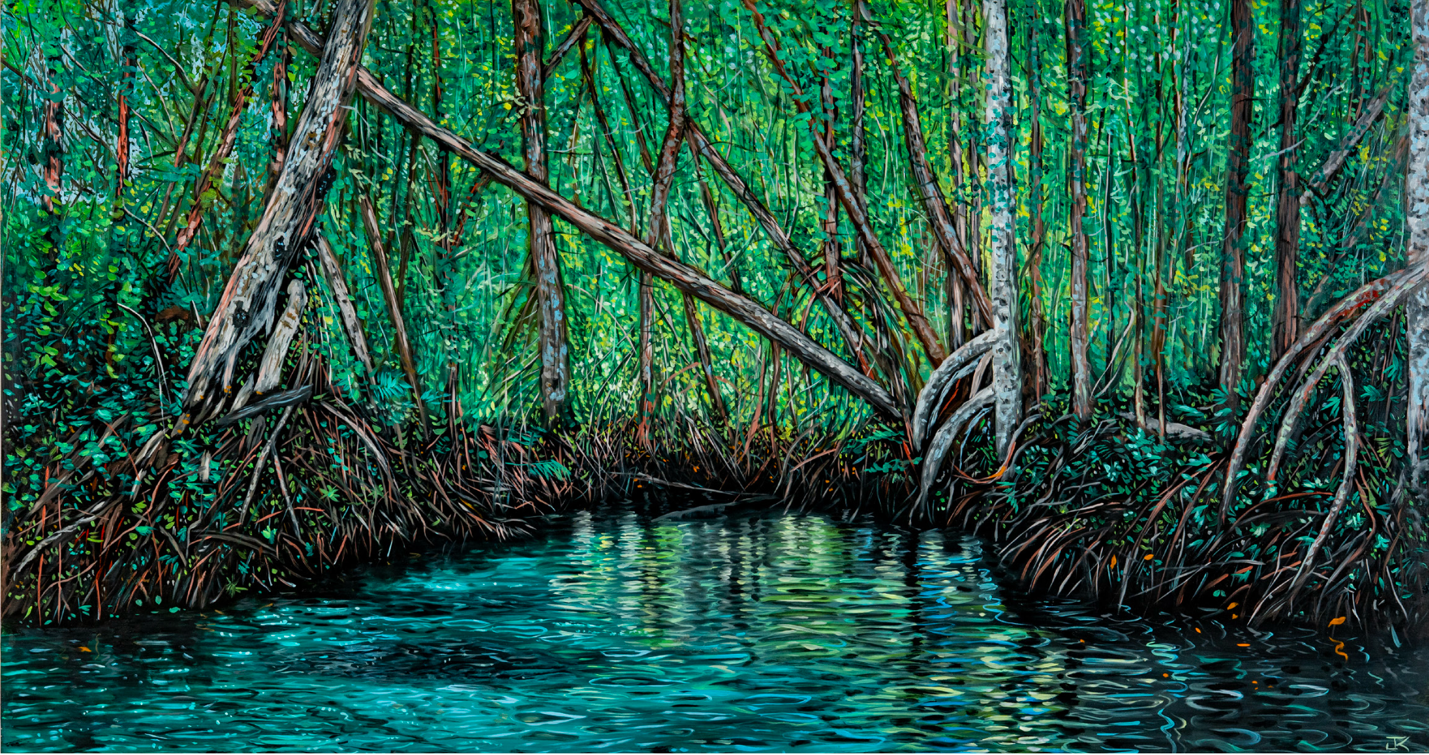
Jason Kennedy, Mangroves, 2024, Acrylic, sea water, and oil on board, 30 x 55 inches
The transforming of ecosystems is perhaps most assertively represented in Iain MacRae’s triptych paintings teem with tropical species, cartography of their habitats across the Islands. The shy brown fur of the agouti and the beaks of seabirds emerge in fragments from the paint, but even these classic Cayman icons are not endemic to the islands. Introduced species, some invasive, some agricultural, wrestle across the canvas with the native organisms, and looming amongst them all in emblematic boldness are the logos of import, finance, and real estate corporations.
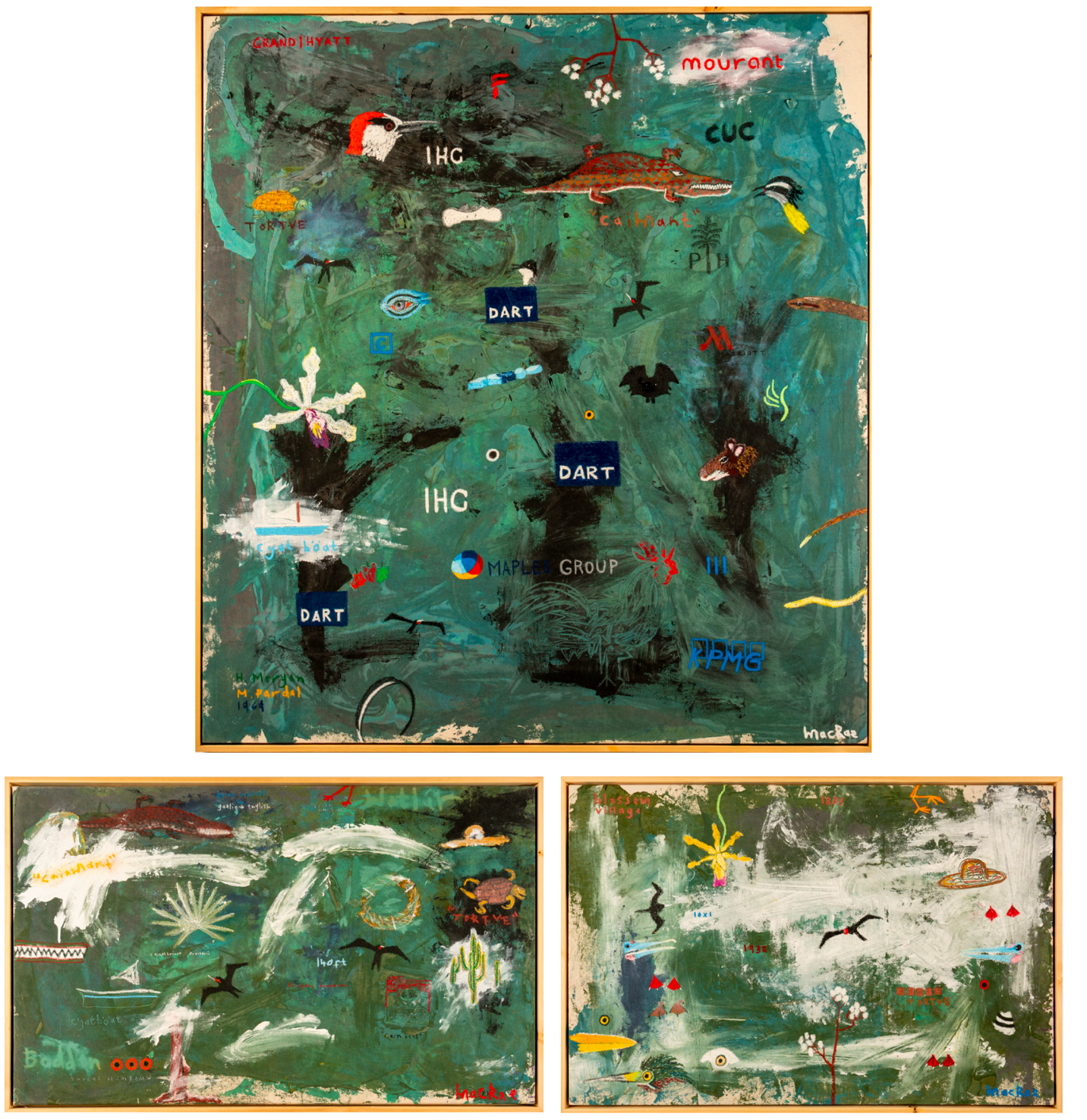
Iain A MacRae, Grand Cayman, Cayman Brac, Little Cayman, 2025, Acrylic, oil stick, oil pastel, and pencil on unprimed canvas, 63.5 x 58 inches, 30 x 48 inches, 31 x 45.5 inches
The artists of the Cayman Islands know that nature cannot be insulated from the political. And the co-curators know this as well. Davin K. Ebanks and Joseph L. Underwood have offered three conceptual lenses through which to view the 76 artworks across 6 venues and 3 islands: Culture Shift, Social Dynamics, and Ecological Legacies. These subthemes overlap and intertwine, each a meandering footpath leading back to the biennial’s overarching premise, the titular, “Archipelago.” A collection of islands, a collection of cultures, a collection of people: an archipelago is simultaneously isolated and vitally interconnected. Migration, modernization, and a proliferating tourism industry have completely reshaped island life. This, in turn, has reshaped the land, the sea, and all the creatures that dwell there. Some artists contend with nostalgia, like Nasaria Suckoo Chollette, whose sensitive textile and found object portrait of her grandmother hearkens to memories lost and a way of life no longer passed down (Fig. 3). Some artworks fear for the future, like Kay Smith’s collage were a young woman in a gas mask makes her way through Grand Cayman’s notorious landfill “Mount Rashmore.” (Fig. 4).
Beyond the endless flood of garbage, apristine mansion is encased in a glass snow globe—the perfect trinket takeaway for a tourist-driven economy. Some artworks dream, like Yonier Powery’s ceramic sculpture Resilient (Fig. 5). A hand sculpted tortoise carries a windswept house on its back. Mythological and surreal, the animal appears to be in a state of endless migration. Perhaps this island in the archipelago will be its home, or perhaps the next one.
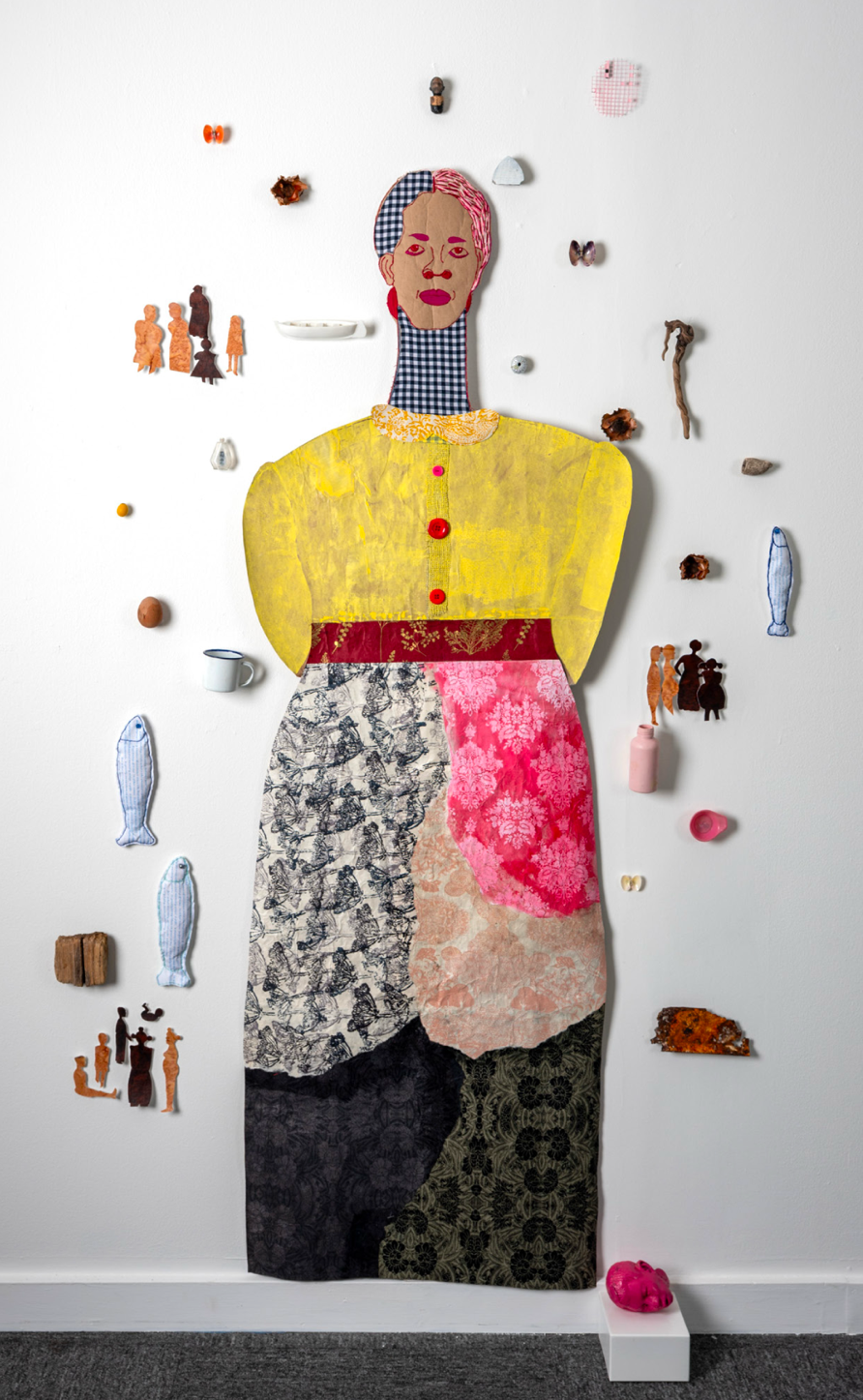
Nasaria Suckoo Chollette, Where the Water Touches Me, 2025, Found objects, shells, brown paper, patterned paper, acrylic, buttons, cloth, quilting, 60 x 72 inches
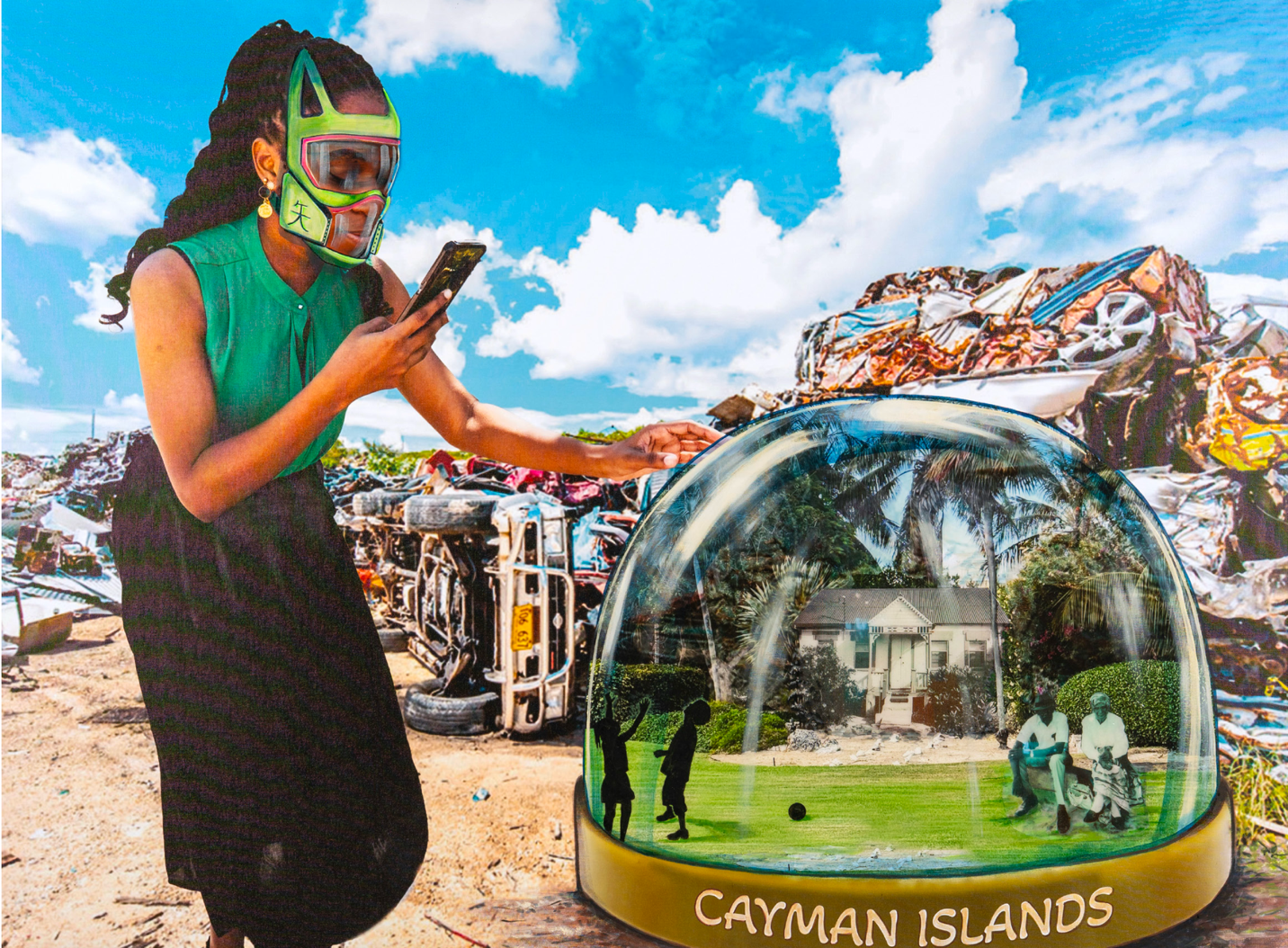
Kay Smith, Echoes Through the Archipelago, 2025, Digital photograph, acrylic, collage, resin, 43 x 58 inches
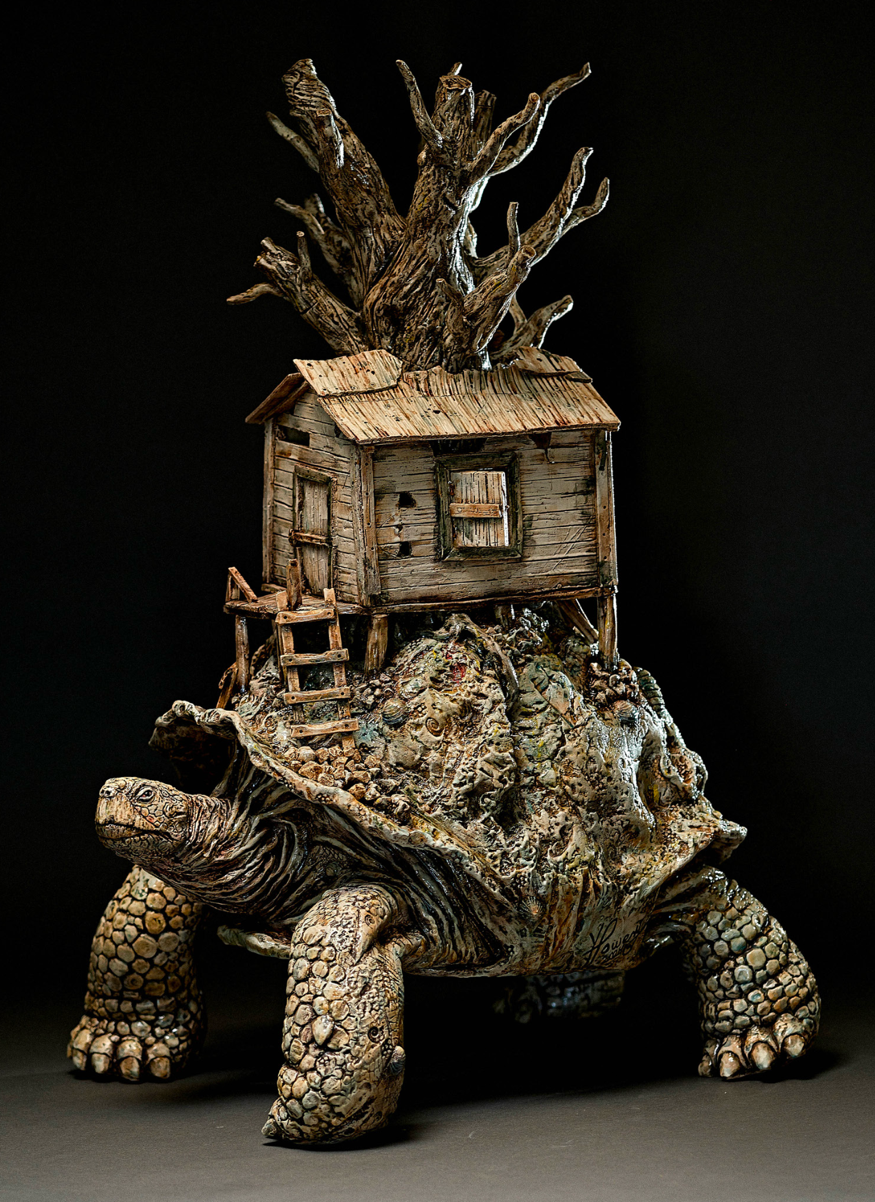
Yonier Powery, Resilient, 2024, Ceramic, 30.5 x 15.5 x 21.5 inches
Some of the biennial’s most powerful artworks lie beyond the gallery walls. Enclosed within the concrete ruins of a former grocery called Gram Bella’s, a monumental installation unfurls beneath the sky. Artists Stefan Langlois and Elizabeth Paige Smith have inhabited the old structure with ghostly figures. Tall carved wooden ship masts jut from the earth in Ode to Ten (Fig. 6), Langlois’ dramatic interpretation of the 1794 Wreck of the Ten Sail, when a fleet of British ships crashed into the reef. They shatter outwards like palisade fortifications from the hollow façade of the store.
Imposing in form and deft in fabrication, the sculptures seem like both a memorial and a warning. It is after all, only the survivors who get to tell the stories of the past. Deeper within the ruins, Smith has left a choreography of figures in repose. In It and Of It (Fig. 7) is the title of the largest of these characters: a vast fossilized body made of cast Cayman Dolostone. Embedded like barnacles, her skin is layered with coral, onch shells, and rusty metal. Who knows how long she has lain there, but this accretion suggests she is ancient. The installation at Gram Bella’s is as much about the resilience of the Caymanian people as it is about the permanent impact that humans have had on the landscape of the islands.
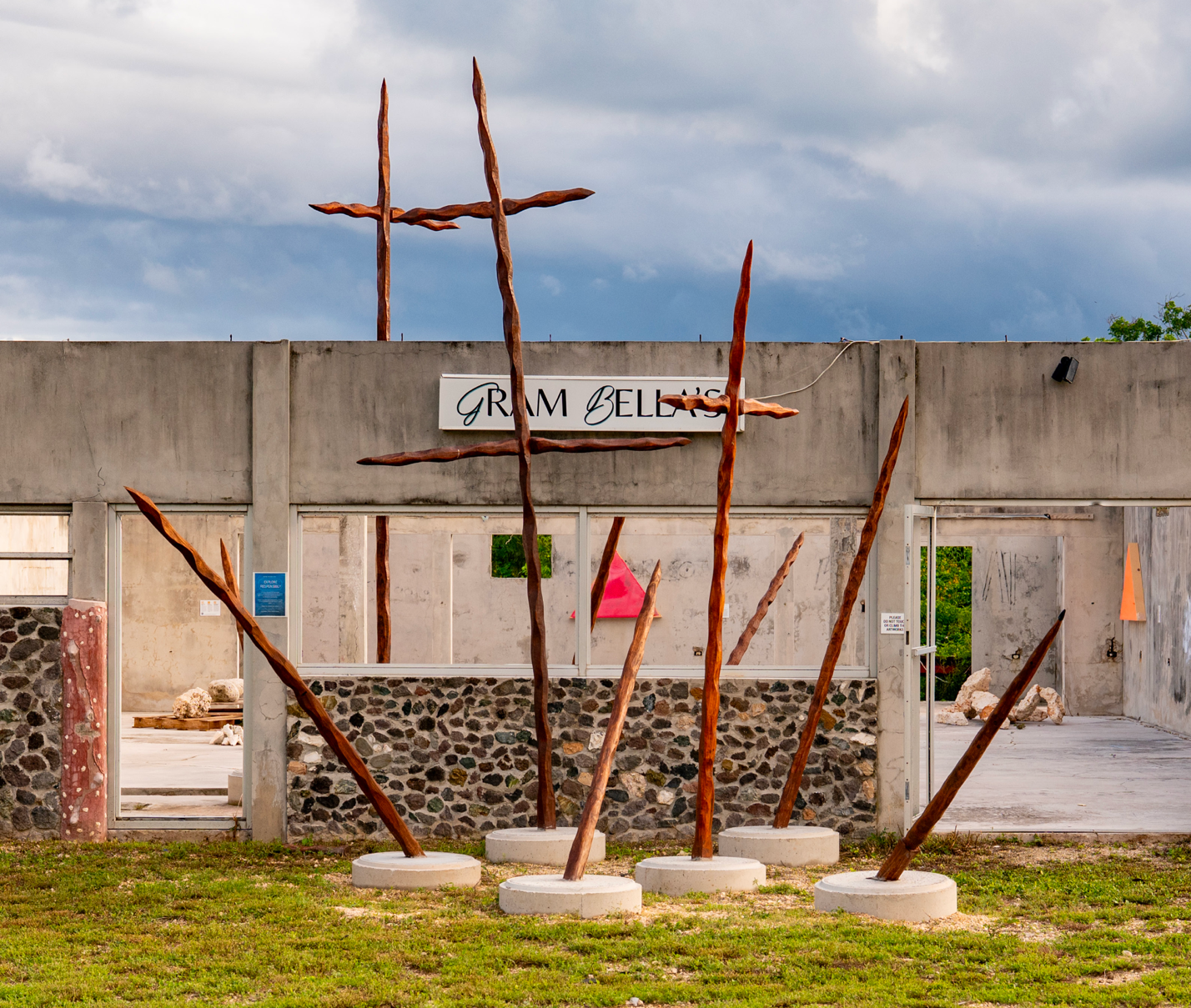
Stefan Langlois, Ode to Ten, 2025, Reclaimed wood, stain, concrete, dimensions variable
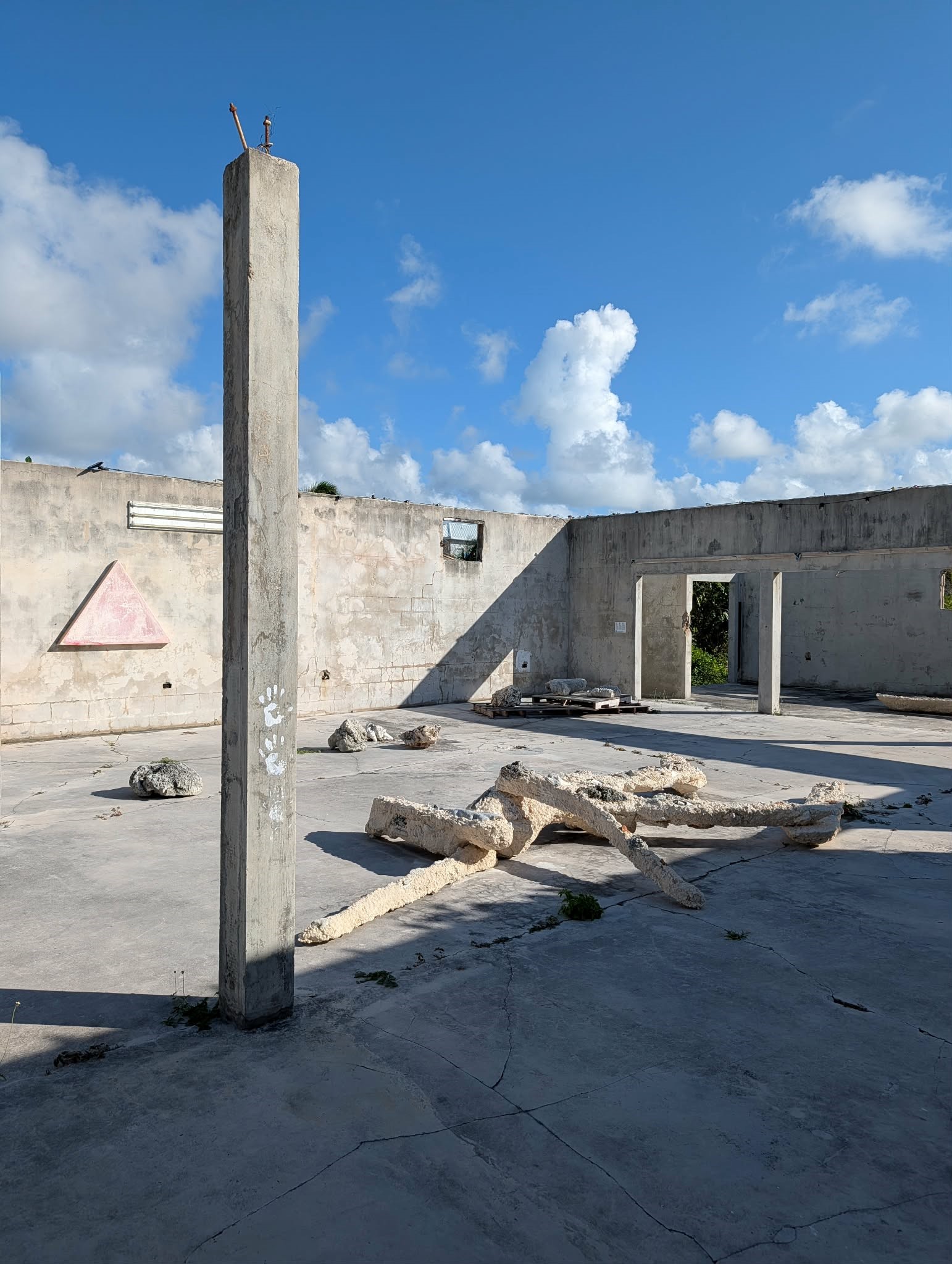
Elizabeth Paige Smith, In It and Of It, 2025, Cement, crushed Dolostone, coral stones, shells, sand, metal, 20 x 9 feet
Archipelago is an exhibition that lives up to its title; its artists still navigate the restless Caribbean waters much like their maritime ancestors. They create in the face of ecological threats from overtourism and overdevelopment, as both ecosystems and memories erode into the sea. The explosion of the Cayman Islands’ contemporary art scene seems to mirror the explosion of their industries and population since the 1970’s. Artists like Janet Walker grace the walls of the permanent collection in the National Gallery with sundrenched watercolors of palm trees and hammocks, painted in the 60s and 70s. The work exhibited in the biennial is fundamentally different: more concerned, more critical, more political. When I reached out to the curators asking about why these contemporary artists feel so radical, Davin K. Ebanks gave plenty of credit to the Native Sons, an art collective whose members have professionalized the art scene since the 90s. Ambitious in scale and medium, with delicate discernment for what makes the socio-cultural experience of their islands so unique, their members have been highlighted in many prior editions of the Cayman Islands Biennial. Ebanks also praised the leadership of the National Gallery, directed by Natalie Urquhart, who has transformed the expectations of the art scene. Implementing open calls, drawing in artists with MFAs, curators, and researchers; this has set a new standard which the biennial is one facet of.
Many of these artists depict the contemporary conditions of nature and recognize the responsibility they have to go beyond the saccarine palm tree paintings feigning that all is well in paradise. There are many conceptual parallels between the art of the biennial and the eco-art scene in my home, New York City. 2025 saw the towering art and ecology showcase Water Stories, at BioBat Art Space in Brooklyn, NYC. One of the core storylines of Water Stories was that there is no wild, untouched nature left on earth. Nuclear fallout smolders in the deepest hadal zones of oceanic trenches. Microplastics float in cirrus clouds and fall in precipitation. The human impact on earth has been geological, meteorological, and cosmic in scale. While Water Stories looked to science as the tool of our salvation, Archipelago looks to each other. There is a keen awareness of our dependency on one another, calling for community and accountability, and preserving the land and its heritage for future generations. The graffiti artist Magpie very candidly asks this question, with a spraypainted emblem included on all three islands: “What is it Worth?” (Fig. 8) Illustrating a pair of sea turtles and a scale weighing stacks of currency, there is a sense that if he could, Magpie would tag every government building and corporate office with this graffiti. There is both individual and collective responsibility as island life continues to undergo rapid transformations. Magpie reminds us of this, and he insists that Caymanian people continue to share their stories. Archipelago becomes a framework to amplify these stories and place them in new contexts, bounding from island to island, from town to town, and from soul to soul.
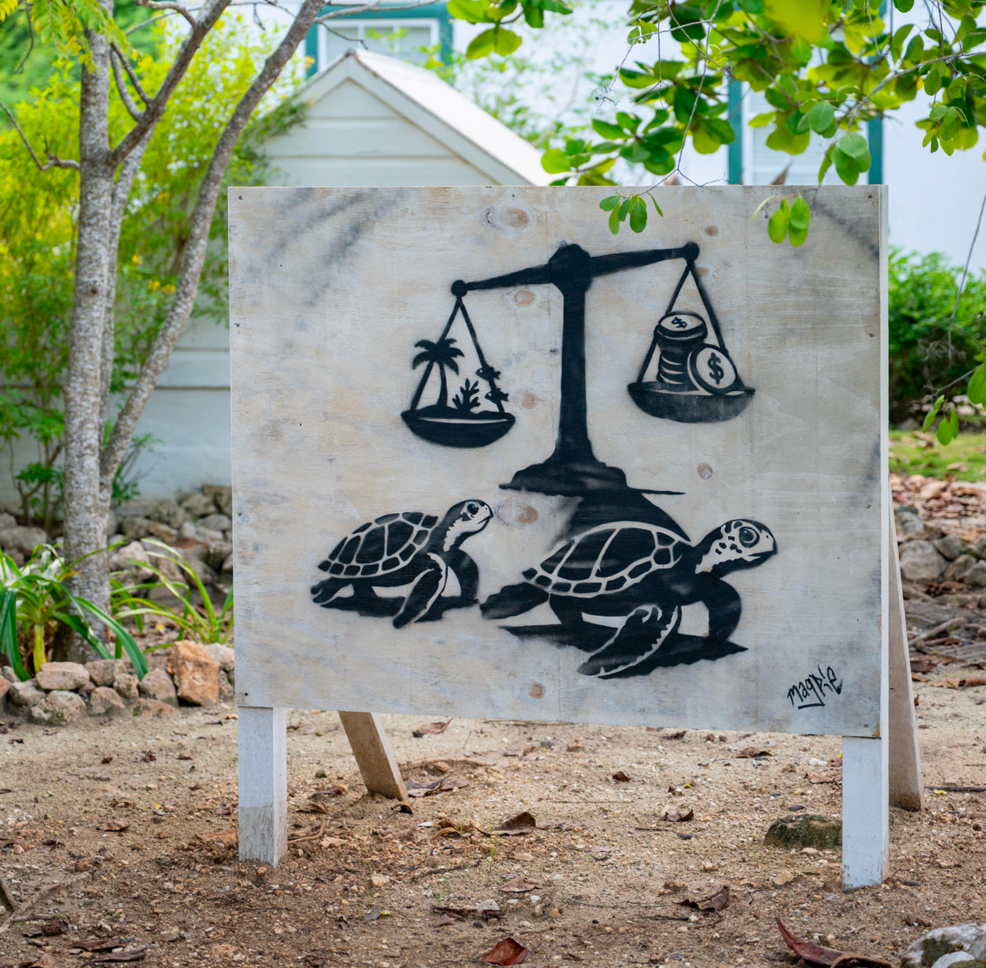
Magpie, What is it Worth?, 2025, Spray paint and stencils on reclaimed wood, dimensions variable, installation shot at Mission House, Bodden Town, Grand Cayman
Ezra Campelli is an arts professional at the International Studio and Curatorial Program in Brooklyn, New York. They work as an artist, curator, ecologist, and performer.