Artist and writer Dineke Blom visited the exhibition Bitches Brew at the Bonnefanten museum (Maastricht, the Netherlands) and wrote an impassioned essay exploring the role of personal figuration and the extent to which it reveals the artist. ‘In Bitches Brew, Keetje Mans, Tanja Ritterbex, and Aline Thomassen put an unexpected spin on personal figuration. ‘I take a life as lived by a woman as my starting point for each of the three exhibitions. The three artists share a great deal of their own lives—both in conversations with one another and through figurative elements in their work. Surprisingly, that open, personal aspect actually convinced me that Thomassen, Ritterbex, and Mans are masters of the art of concealment. False trail, smokescreen, witches’ brew—it is all encapsulated in that intriguing group portrait accompanying the exhibition.’
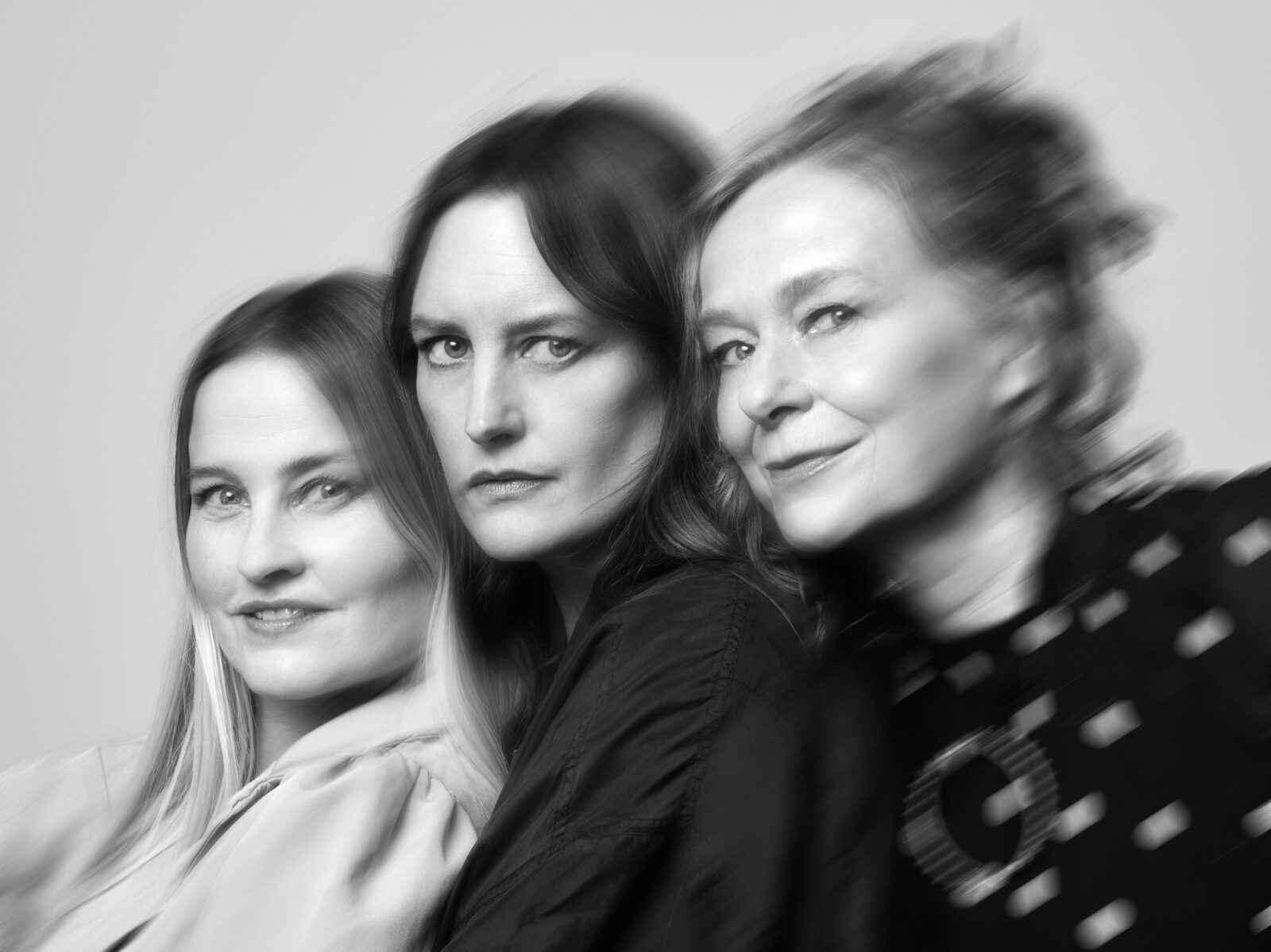
Robin de Puy – Portret Bitches Brew (v.l.n.r. Tanja Ritterbex, Keetje Mans en Aline Thomassen), 2025. © Bonnefanten.
False trail, smokescreen, witches’ brew: how personal is a figurative painting?
‘A figurative painting depicting Black persons does not represent Black persons any more truthfully than an abstract painting can.’ I find the quote among my notes, without name or date, and jotted down when I was researching abstract working Afro American artists from the 1960s and 1970s. ‘Would the quote’s thesis also apply to a figurative painting depicting women?’ I wondered when I visited the exhibition Bitches Brew at the Bonnefanten museum. And what if the painting also appears autobiographical — would that make it an even truer reflection? A reflection of what, exactly? These are questions that the exhibition raises for me as a viewer.
Three artists, each with a separate show, are central to Bitches Brew, collected under that overarching title. All three are women, a fact that is relevant to my account. All three make figurative work, and I see the depiction and representation of women as a common thread in their work. ‘Woman’, ‘personal’ and ‘autobiographical’ can be a problematic combination because the work risks being reduced to a highly personal artistic expression. When, long ago, I studied the work of the artist Florine Stettheimer (USA, 1871–1944) I saw precisely that happen, in a laudatory review by Stettheimer’s colleague, contemporary and admirer Marsden Hartley. His inability to grasp her hyper-feminine figuration is evident in the words he used to characterize the work as an “ultra-lyrical expression of an ultra-feminine spirit,”thus effectively smothering it. [1] A more recent example is Tracey Emin’s installation My Bed (1998) — an unmade bed surrounded by objects on the floor that suggest a days-long uninterrupted stay in that bed. In outward appearance Emin’s installation is the antithesis of Stettheimer’s precious installations. However, the initial reception of Emin’s work echoed something of Marsden Hartley’s helplessness: “people didn’t know where to put themselves in relation to the work, because it included the full range of an ordinary woman’s life experience.” [2] By now, in the visual arts an ordinary woman’s life experience as such will not raise eybrows. Wikipedia rightly describes Stettheimer as ‘modernist painter, feminist, theatre designer, poet and salonnière.’
Keetje Mans, Tanja Ritterbex and Aline Thomassen give a surprising twist to personal figuration in Bitches Brew. I take a life as lived by a woman as my starting point for each of the three exhibitions. The three artists share a great deal of their own lives—both in conversations with one another and via figurative elements in their work. Surprisingly, that open, personal aspect actually convinced me that Thomassen, Ritterbex, and Mans are masters of the art of concealment. False trail, smokescreen, witches’ brew—it is all encapsulated in the intriguing group portrait that accompanies the exhibition.
Not that their work is hermetic or impenetrable; it presents different angles from which one can look at, contemplate and fantasize over the life of a woman and/or female artist. In that sense it transcends the personal experience of the artists, however autobiographical their work may appear. What role personal figuration plays and how transparent it makes an artist is, to my mind, the overarching question the exhibition raises. Any answer to this question strikes me as complex from the outset, if only because I immediately think of a remark made by artist Mark Bradford, who happens to make abstract work. His answer to the question posed to him whether abstraction protects him from transparency was: ‘No. I think I could lie better through figuration. I could lie better with more props.’ What then do I think of, when looking at Keetje Mans’, Tanja Ritterbex’ and Aline Thomassen’s work in Bitches Brew, other than of the artists as persons? That is yet another question that came to my mind.
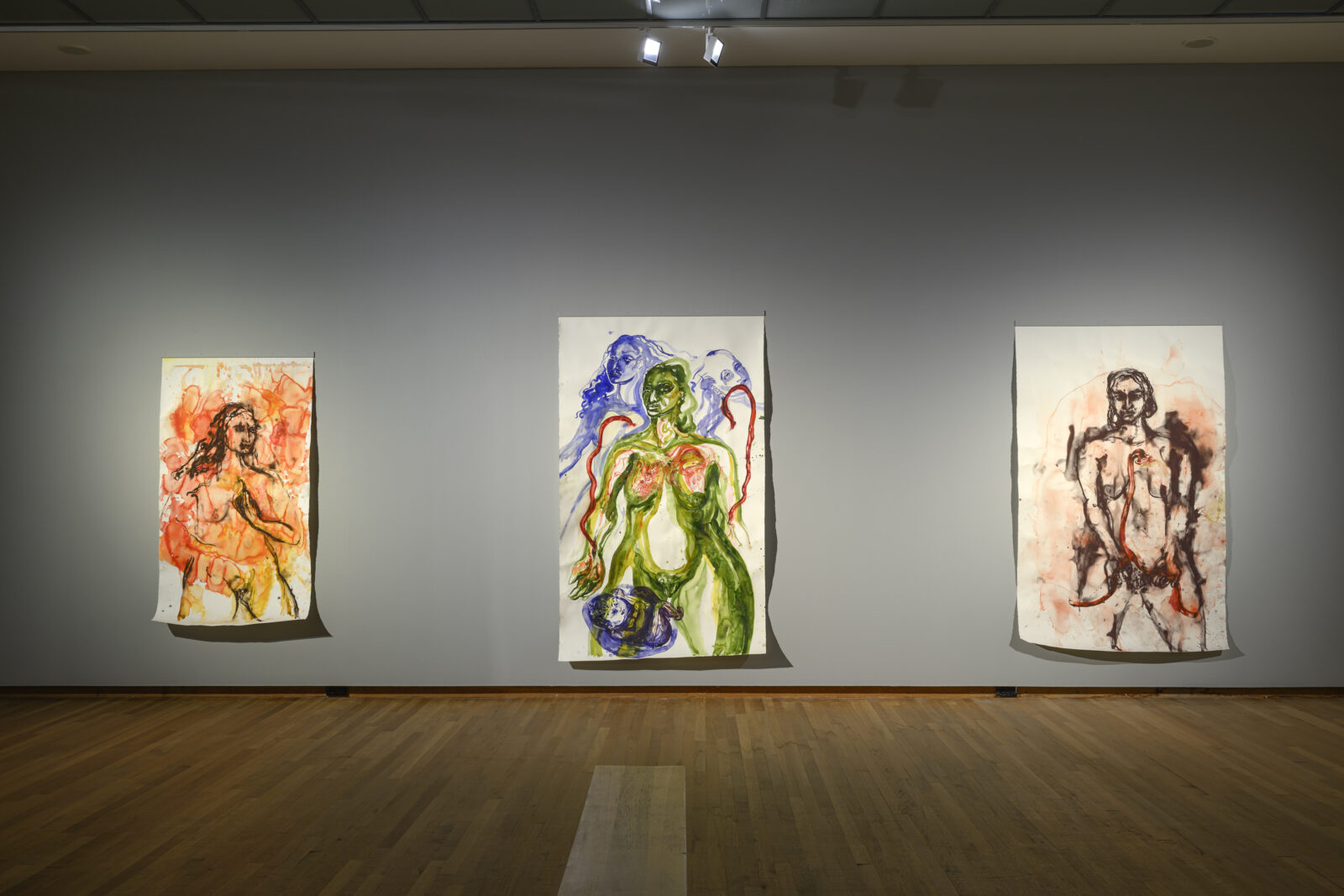
Aline Thomassen – overview I am You- You are Me (part of the project Bitches Brew), Bonnefanten 2026. Foto: Peter Cox.
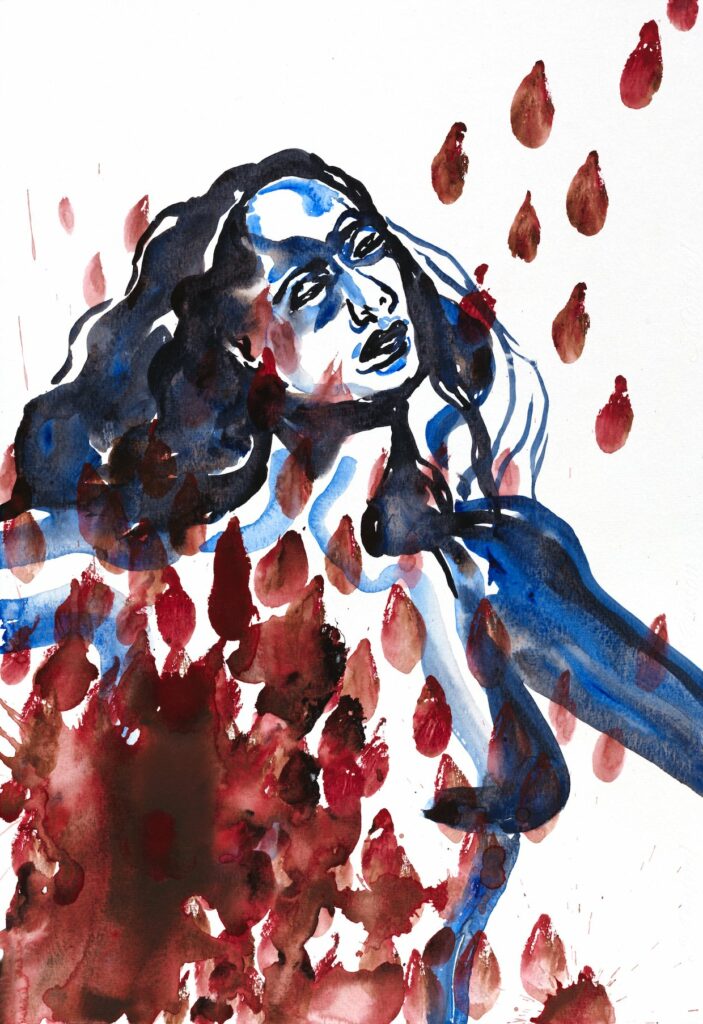
The title of Aline Thomassen’s exhibition is I am You- You are Me. In an interview with Aline Thomassen on the occasion of her winning the Ouborg Prize, her interviewer argued that her work ‘is about women.’ Thomassens’s response was: ‘They never ask say that about work that depicts men. So it’s about what those men and women do, what they express. It is about the content: struggle, internal struggle, etc., feelings that hopefully are universal, but they are presented by a woman.”[4] What Thomassen says here I see reflected in her section of the exhibition. The large back room shows a long horizontal row of depictions of women. They are naked, or rather they wear no clothes. For Thomassen clothes refer too much to the outside world, whereas she is interested in an ‘inner’ world. The body is what connects those two worlds.[5] In several of these images the bodies lay partly open and/or the watercolor painting dissolves into a proliferation of organs, umbilical cord, suggestions of plant forms, leaving the image battered.
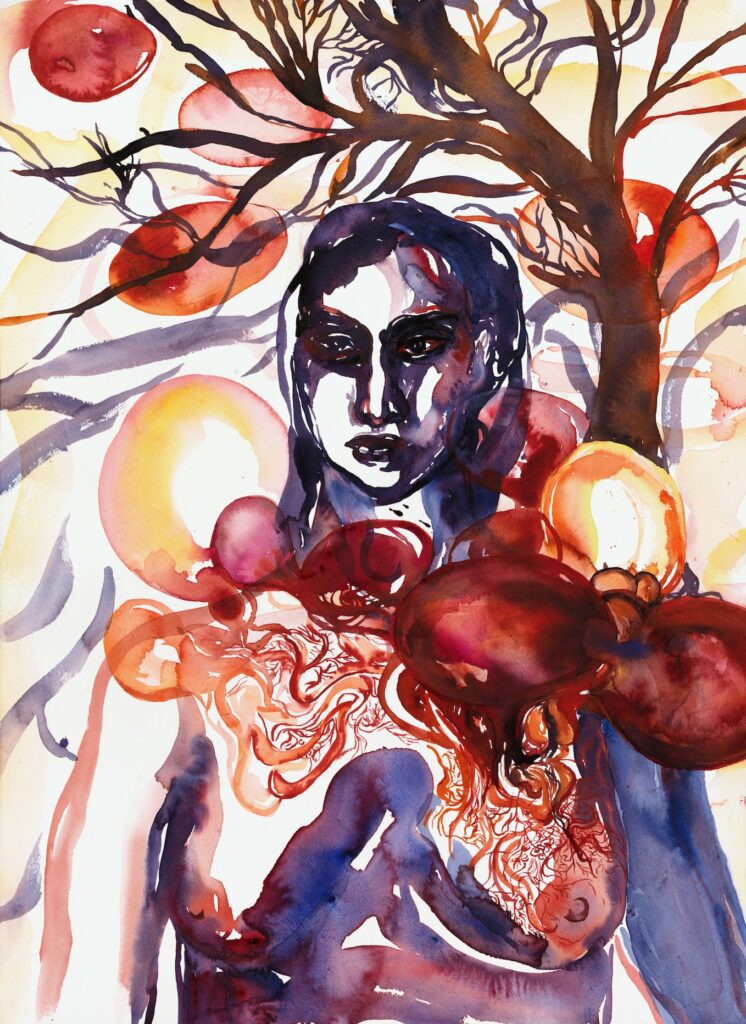
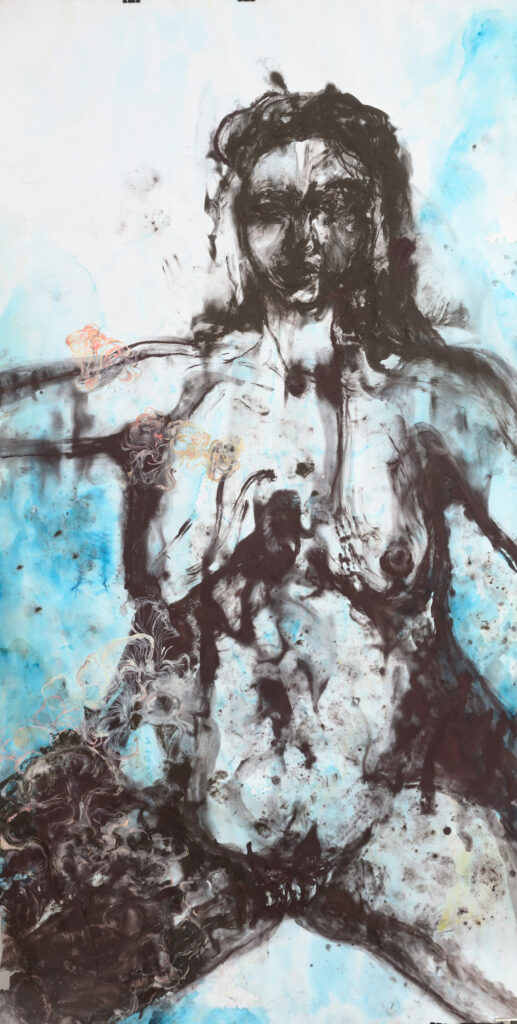
Aline Thomassen – view, I am You- You are Me (part of theproject Bitches Brew), Bonnefanten 2026. Foto: Peter Cox.
I doubt that I am the only one who, at ‘naked’ and ‘being a woman’, thinks of what John Berger’s essay says about it being impossible for a woman to be truly naked as long as the eroticizing male gaze ‘dresses’ her naked body.[6] But there is no eroticizing gaze beneath the nudity that Thomassen paints. What strikes me about the long row of depictions are the faces, the look in the women’s eyes. Some meet your gaze and others look away. However intrusive, naked and open the depicted women may be, I do not get an insight into what goes on inside them, no glimpse of their inner world. That contrast makes me reflect on the relationship between being visible and not showing everything, between being naked and yet not making oneself transparent. The questioning (and/or averted) gaze of the women invites one to think bigger than the plight of a single individual woman, because what they represent concerns “the content: struggle, internal struggle, etc., feelings that hopefully are universal, but they are presented by a woman.” In this light the portraits invite me as a viewer to examine how this content stirs my own inner life, because I am You- You are Me.
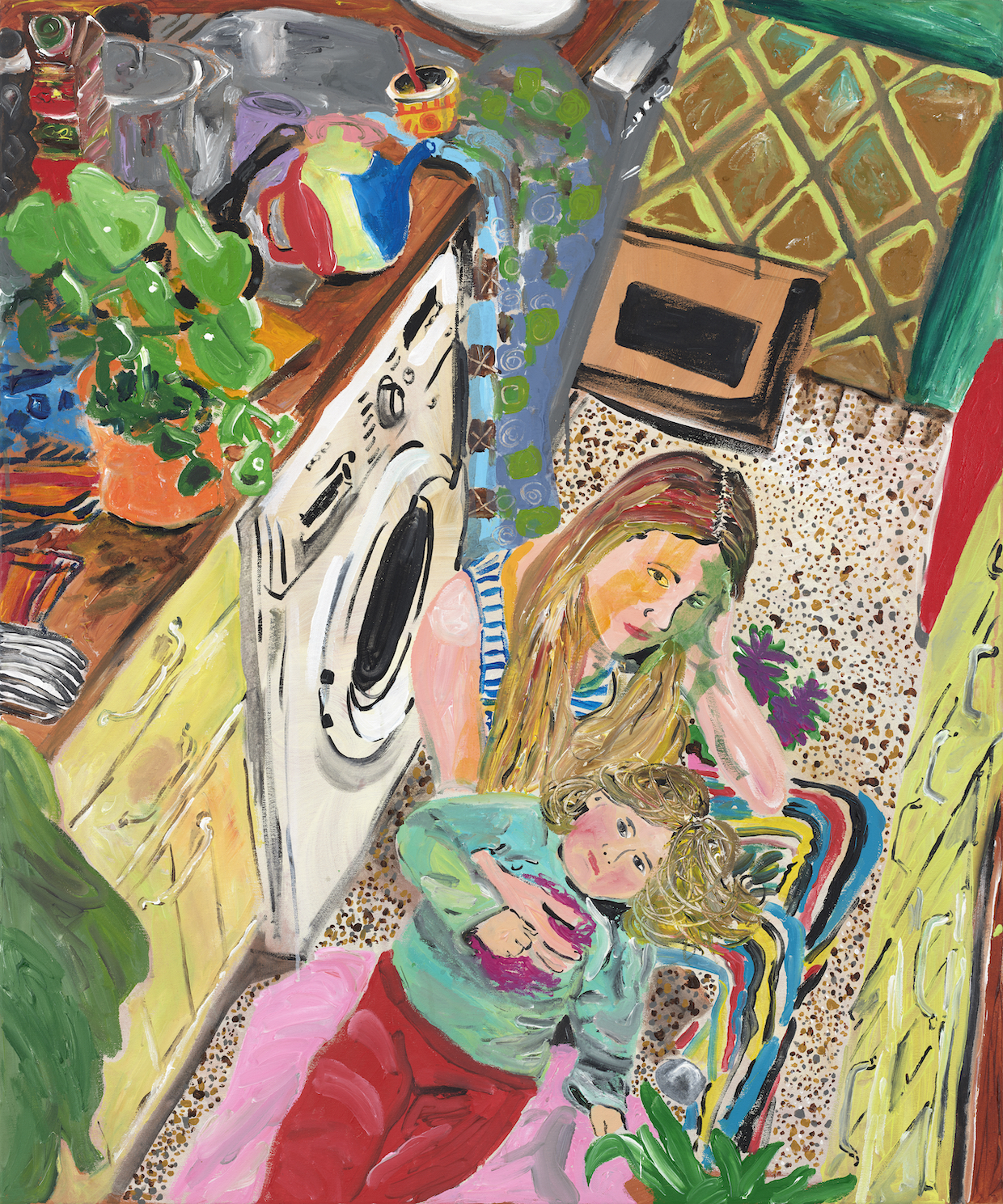
Tanja Ritterbex – Laundry Day, acryl op doek, 2025, 120 x 100 cm. Courtesy ING Collectie, Amsterdam. Foto: Eric Tschernow.
The work of Tanja Ritterbex in her exhibition Mama Steht Kopf, is at first glance the most personal and autobiographical of the three artists. She always starts from her self-portrait and in interviews she comes across as ‘honest’ and direct; for example, there is hardly any time between a question and Ritterbex’s answer. But Ritterbex too, is a master of concealment. And however fast her answers may come, those answers are preceded by considerable reflection.
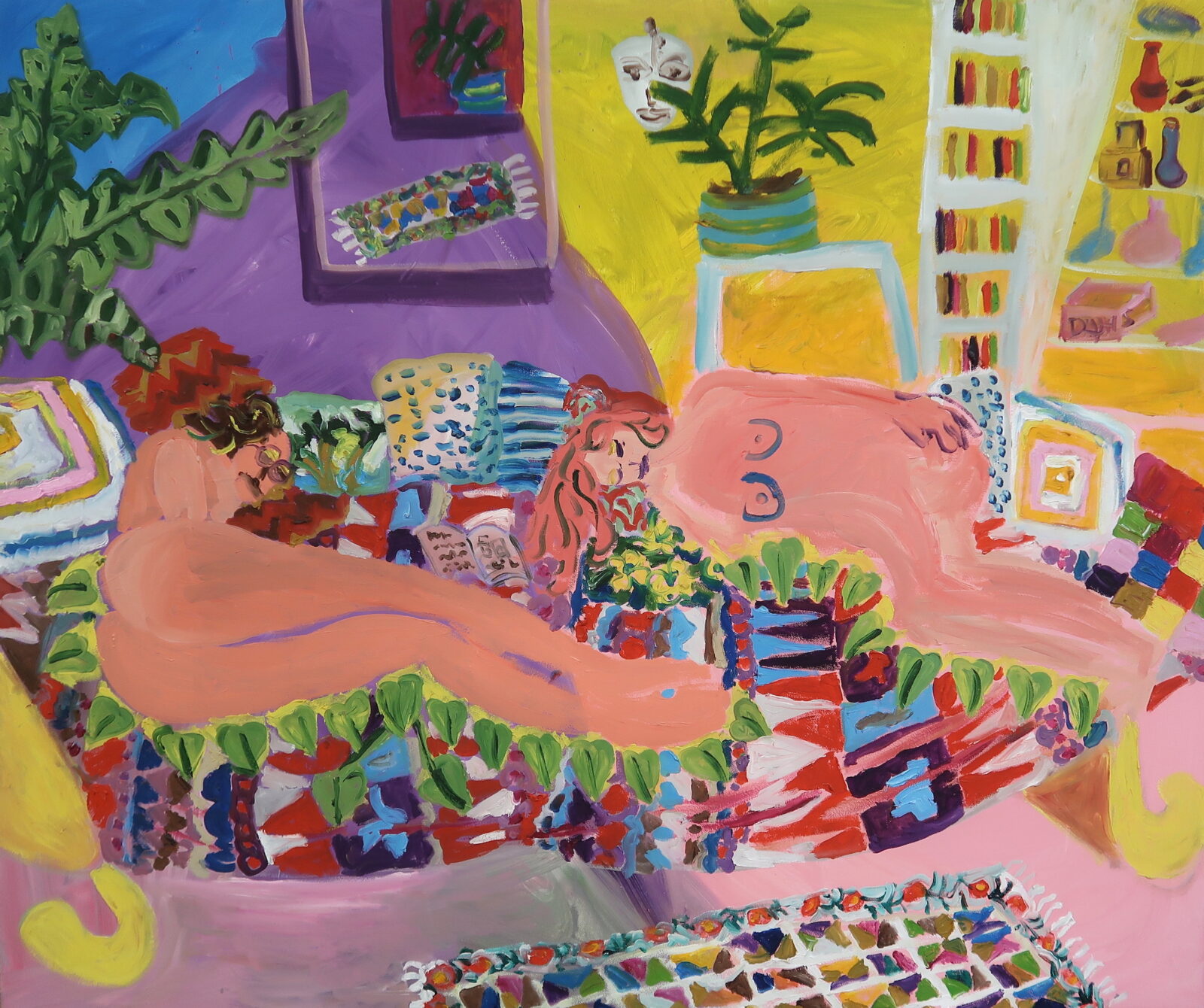
Tanja Ritterbex – Friends Sleeping, 2017, olieverf op doek, 120 x 100 cm. Courtesy particuliere collectie.
Her methodical working method is a case in point., The series of daily selfies (Selfie Series, 2015-2016) for example, ends at number 365, a rather impersonal breaking-off point: the number of days in a year. What follows is reflection on those selfies, for instance by posting them on social media, consider the responses, and then painting them — sometimes with acrylic paint because it can show more quickly than oil paint what image her thinking has produced. And here in Bitches Brew by making a selection from that series of small paintings.
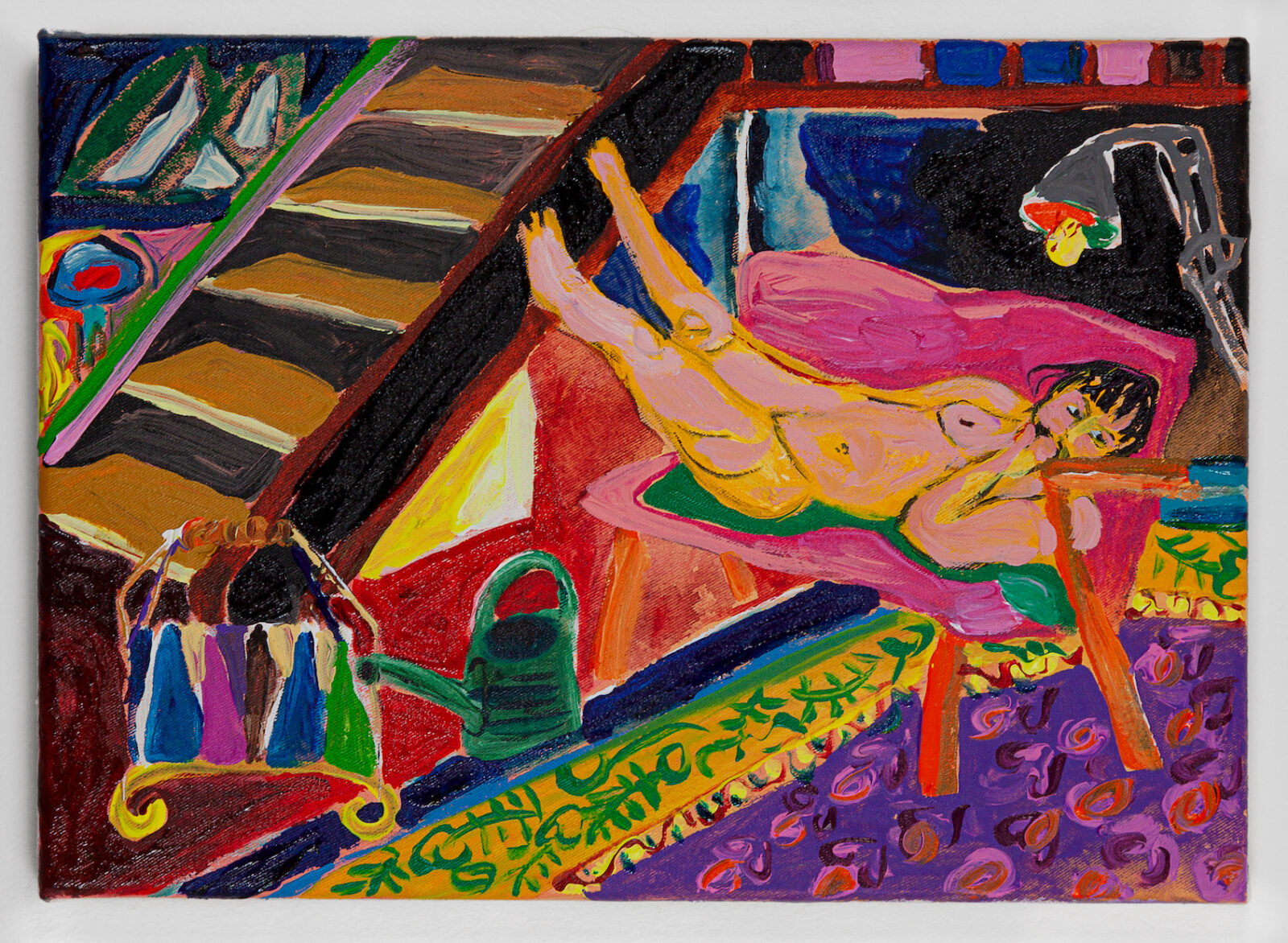
Tanja Rotterbex – Self-portrait with Stairs, 2023, acrylverf op doek, 25 x 35 cm. Courtesy particuliere collectie.
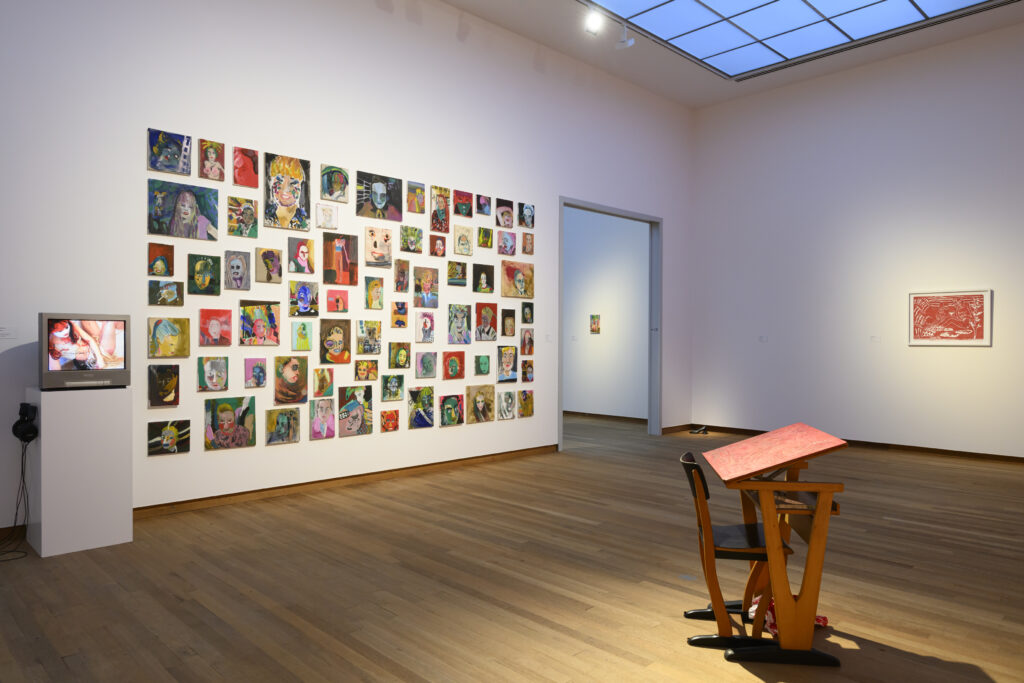
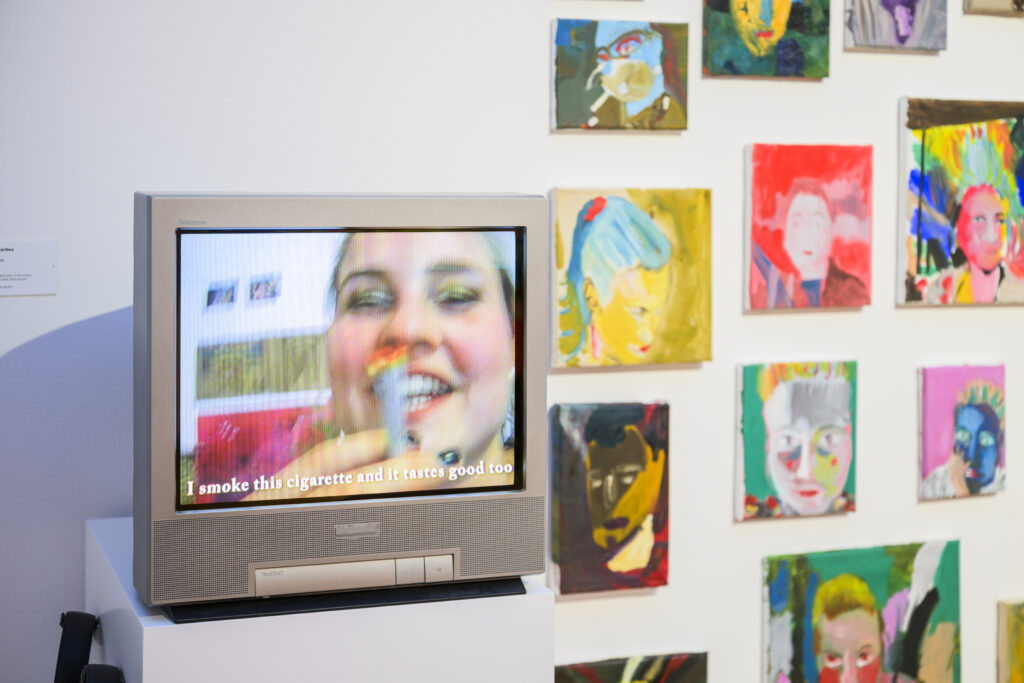
Tanja Ritterbex, overview, Mama Steht Kopf (part of the project Bitches Brew), Bonnefanten 2026. Foto: Peter Cox.
In the accompanying video (Selfie Video, 2026) we see Ritterbex doing a minutes long dance in her studio. It is an intense and intimate image, with no audience. To me the video evoked instant happiness, because what I see is so liberating — as an artist you have your own biotope, your studio; that is your domain, there you are free. Yet for a fraction of a second it flashed through my head: ‘where is the hidden camera.’ But it really is Ritterbex who has placed the camera on herself. She explores an extremely personal moment so as to cast a meta gaze on her art. Ritterbex plays out ‘proximity’ and ‘distance’, just as I saw Thomassen do.
In a radio interview Ritterbex was asked about a painting: ‘You show yourself but also not. Which version of yourself do you show?’ Ritterbex answered: ‘The persona Ritterbex? Maybe I am now the mother character?’ The persona Ritterbex observes and questions the world. Those can be questions about motherhood, artistry, or about the fullness of life. Ritterbex was always told during her training that she ‘crammed everything’ into a painting; it was always ‘too full.’[7] Advice to make the image a bit less crammed she always set aside. What would she even omit, what should have been pushed further into the background so we get a full view of what is important? Perhaps life itself is ‘full’ and you do not want to make that density transparent because you want to show that richness, that excess. So why not then put everything on that image, and with as little perspectival depth as possible because that would involuntarily steer you toward ‘in the foreground’ and ‘in the background’.
I see her refusal more as an existential choice than as a formal-aesthetic one. In the latter case her oeuvre would be a long line of cheerful carefree pictures offering a finished worldview. But not a single work is finished in that sense. Her paintings contain too many (conscious) loose ends; forms are ‘frayed’ and ‘provisional’. Ritterbex offers only the bare minimum to recognize a figure, a table, her daughter, her self-portrait, a small rug or towel. The multiplicity is not organized into an orderly whole. Of course Ritterbex makes choices in her paintings but regarding ‘fullness’ she pushes it to the limit. By driving it refers to what, exactly? to extremes, her paintings pose questions about the abundance of impressions from the world. That can be intimidating or appetizing. Precisely because Ritterbex shows the fullness I become aware of the underlying existential question. In this respect the work goes beyond the autobiographical. Ritterbex does not make herself transparent as a person. Instead, as an artist she creates space to raise a meaningful question, for example the question of how one copes with the abundance of impressions from the surrounding world, and how that translates into one’s work.
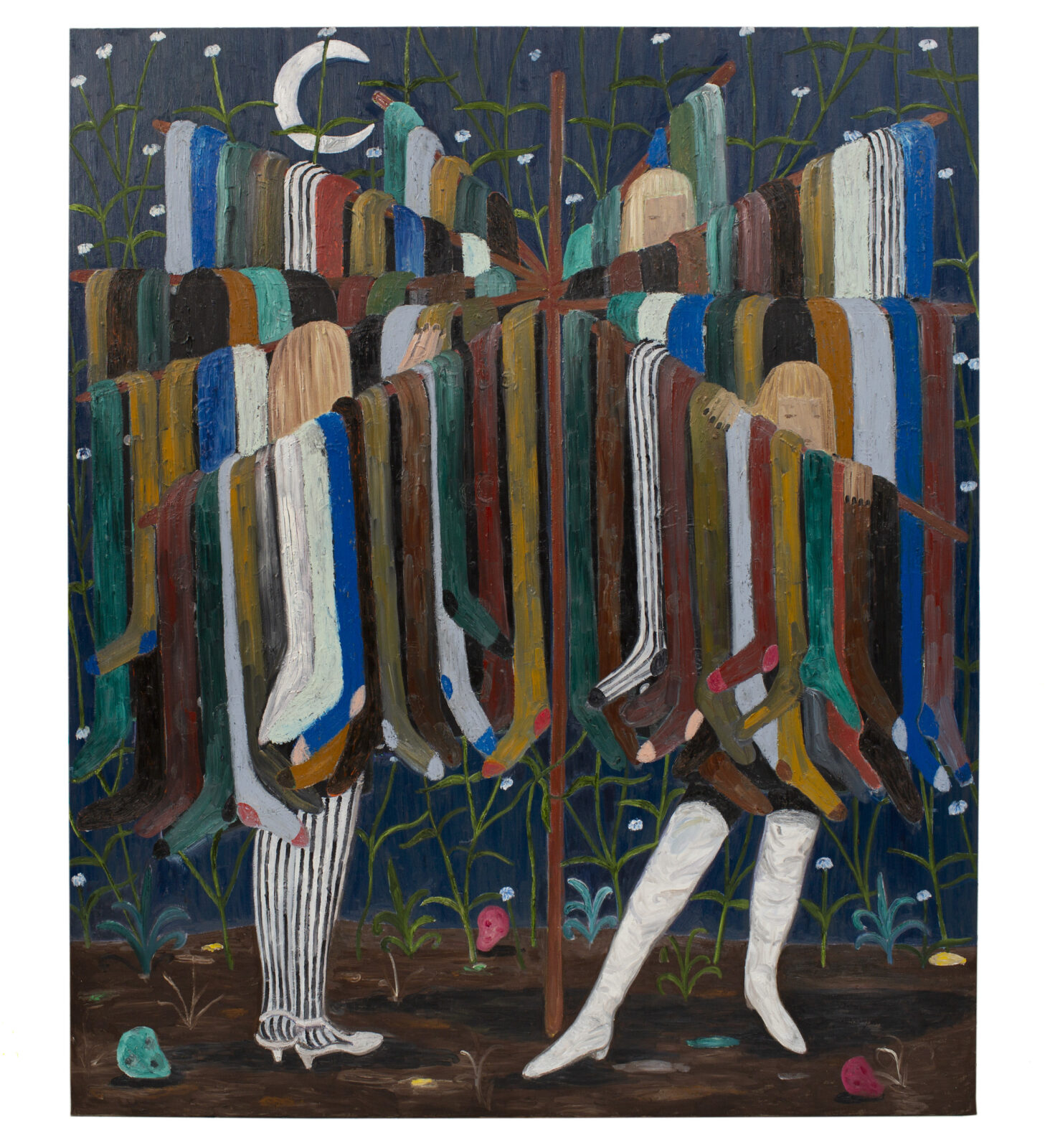
Keetje Mans – Tuesday, 2025, olieverf op linnen, 240 x 200 cm. Courtesy de kunstenaar. Foto: Bert Janssen.
Bitches Brew begins with Keetje Mans’ exhibition Shimmer of Bliss. In the first room works are displayed where the theme of “concealing” versus “giving openness” is most directly visible in both painting technique and figuration. Some paintings show suggestions of people with their faces hidden behind laundry on a clothesline or because the image is cropped exactly where you would expect the face atop a body (or is it a jug rather than a body?).
Also, in most paintings (details of) earlier figuration have disappeared beneath a thick layer of paint. Such spots I find intriguing. The artist Jack Whitten (USA 1939-2018) writes in his collected notes, referring to the paint-skin, that matter is ‘encoded information’ and the surface is thereby the ultimate carrier of content.[8] To me, Whitten’s view applies to Mans’ work.
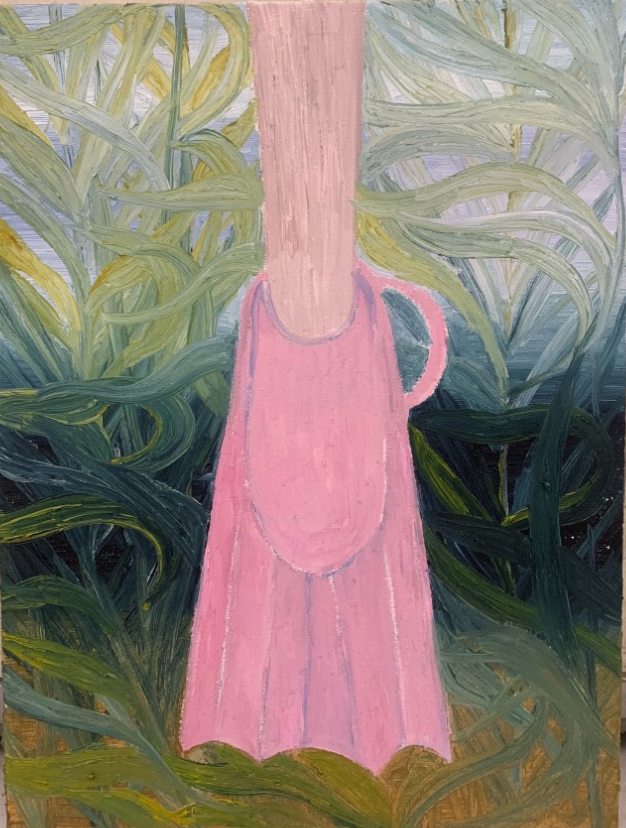
Keetje Mans – Flipper, 2025, olieverf op linnen, 60 x 50 cm. Courtesy collectie Bonnefanten. Foto: Bert Janssen.
Things I Want To Tell You (2023, oil on linnen) may illustrate my point. I saw this painting earlier in Stedelijk Museum Schiedam in the exhibition The roundness of loss (2025-2026). I stood before it for a long time and found it increasingly puzzling. The image is one big disappearing act. Paradoxically, the image as a whole stands like a house, which makes this ‘disappearing act’ pull me into the image even more. The Schiedam exhibition was about loss. Things I Want To Tell You depicts that, in my view — absence, withdrawn from sight; trying to retrieve a vanished image however much that image wants to disappear. And conversely, however much you try to bring it up, it recedes again.
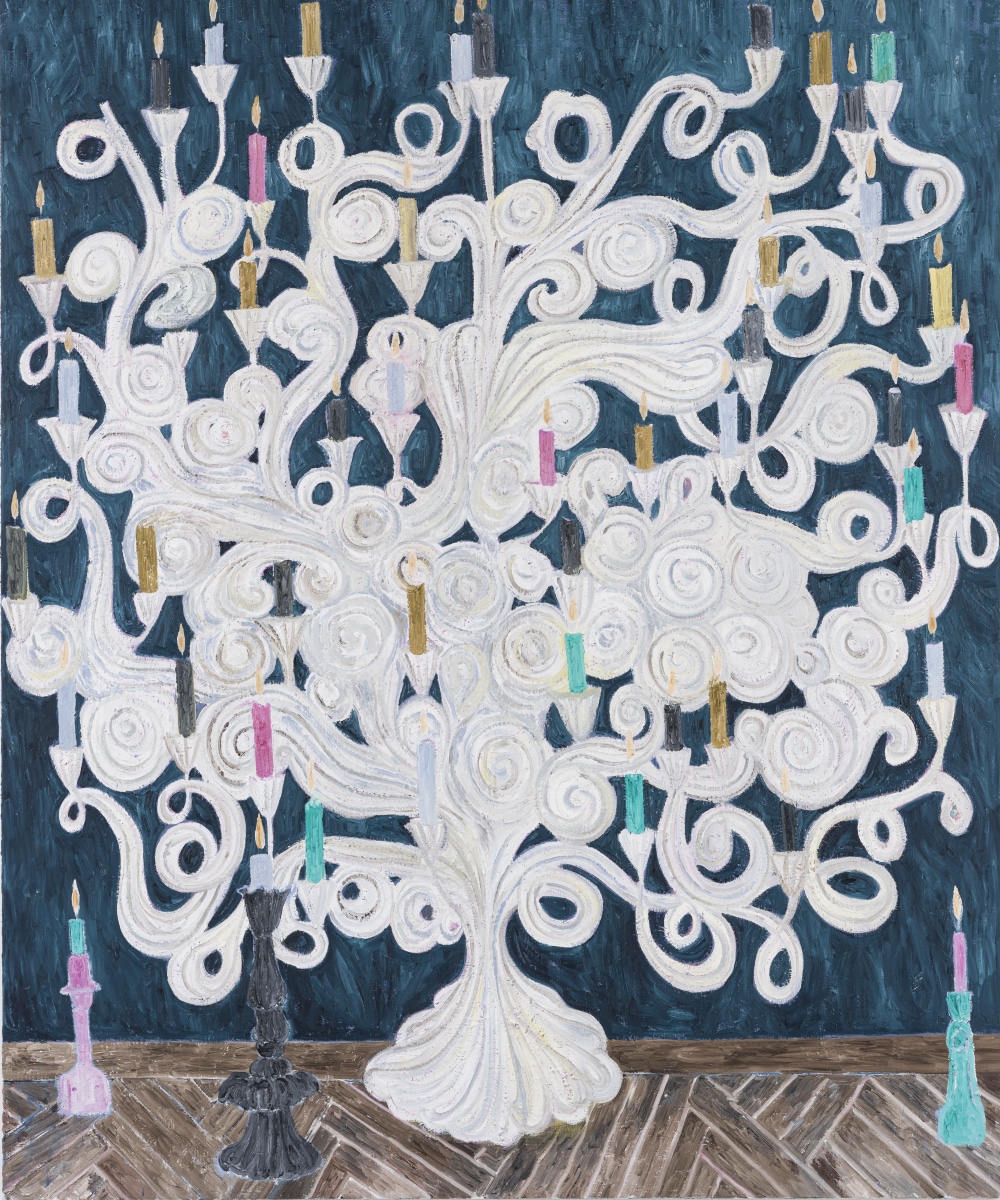
Keetje Mans – Things I want to tell you, 2023, olieverf op linnen, 240 x 200 cm. Foto: Peter Cox.
The way the painting is constructed is a variant of the foreground versus background theme. Everything is actually in the foreground and that foreground is positioned two-dimensionally against a dark rear wall. Background here might be called under-ground in the sense that details that have been painted over now appear as signs of earlier detours, of other choices, roads not taken. Such spots remind me of the poem by Robert Frost:
The Road Not Taken
Two roads diverged in a yellow wood,
And sorry I could not travel both
And be one traveler, long I stood
[…]
And both that morning equally lay
In leaves no step had trodden black.
Oh, I kept the first for another day!
Yet knowing how way leads on to way,
I doubted if I should ever come back.
[…] [1915]
In Things I Want To Tell You the symbolism of extinguished light perhaps plays a role as well; see the little flames that have disappeared under the layer of paint. However, that kind of symbolism does not, in my experience, play a main role in this work. That role is reserved for the bright-white candelabrum with all those tentacle that fills up the image. The vitality of that radiant ornament is in your face. But at the same time the overpainted details underneath this same ornament evoke so much loss and ‘disappearing’ that vitality and visibility are increasingly felt as a provocation. For me this painting is the key to many of Mans’ other works.
To what extent does an artist make themselves.transparent with autobiographical elements in the work, and would the work — because of the personal figuration — be a reflection of ‘what it is to be a woman’? That was what I pondering while walking through the rooms. Keetje Mans, Tanja Ritterbex en Aline Thomassen show aspects of being-a-woman in their work and also use autobiographical elements. They make a life as lived by a woman palpable but they do not claim to show me or make me feel what being a woman is. At the same time they broaden their work, in which so many autobiographical elements can be recognized, beyond the sphere of highly personal experience. So no generalizations, and no reduction to the highly personal.
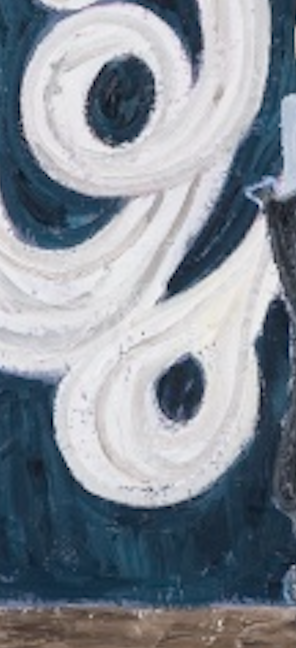
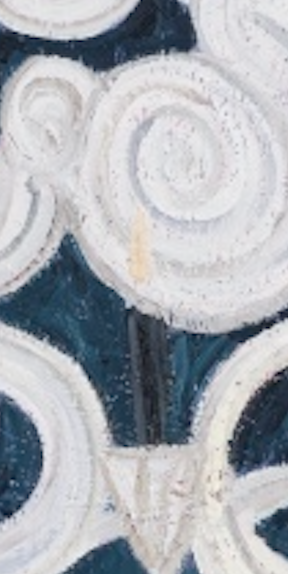
Keetje Mans – detail uit Things I want to tell you, 2023, olieverf op linnen, 240 x 200 cm. Foto: Peter Cox.
Bitches Brew, the exhibition’s title is, I presume, taken from the eponymous album by Miles Davis (1970). Wikipedia mentions that Davis sent his musicians into the studio with the instruction that they could play what they wanted, but on the basis of a simple chord scheme he gave them. The album had to be the result of improvisation, ‘Not some prearranged shit’. Just as the photo of Mans, Thomassen en Ritterbex with the three of them looking into the camera nudged me to a train of thought, so the exhibition title does something similar. Now to make me see the degree of improvisation in the exhibition as a whole. The underlying chord scheme, something in the spirit of ‘the life of a woman’, is implicit. I do not feel a constricting concept to the exhibition; rather I am invited to take part in a living exchange of ideas.
Footnotes
[1]Marsden Hartley, ‘The Paintings of Florine Stettheimer’, Creative Art, Vol.9, juli 1931.
[2] The Guardian, 2016.
[3] Artspace AUG. 12, 2020, interview Anita Hill with Mark Bradford.
[4] Aline Thomassen in Kunstmuseum Den Haag, 2024. Fragment transcribed from YouTube: https://www.youtube.com/watch?v=B59TkmebfOw.
[5] Aline Thomassen in Kunstmuseum Den Haag, 2024. Fragment transcribed from YouTube: https://www.youtube.com/watch?v=B59TkmebfOw.
[6] John Berger, Ways of Seeing, chapter 3, Penguin Books 1972.
[7] VPRO podcast Nooit meer slapen, 5 March 2026; Mister Motley-podcast Kunst is Lang, nr. 45 2017, Luuk Heezen.
[8] Jack Whitten: Notes from the Woodshed, Hauser & Wirth Publishers, 2018, 2025; YouTube: School of Visual Arts Contemporary Perspectives Lecture with Jack Whitten: ‘Matter has the possibility of encoding information, and we can penetrate [into it to access that information]’.
—
The exhibition Bitches Brew can be seen through 6 September 2026 in Bonnefanten museum, Maastricht, the Netherlands.