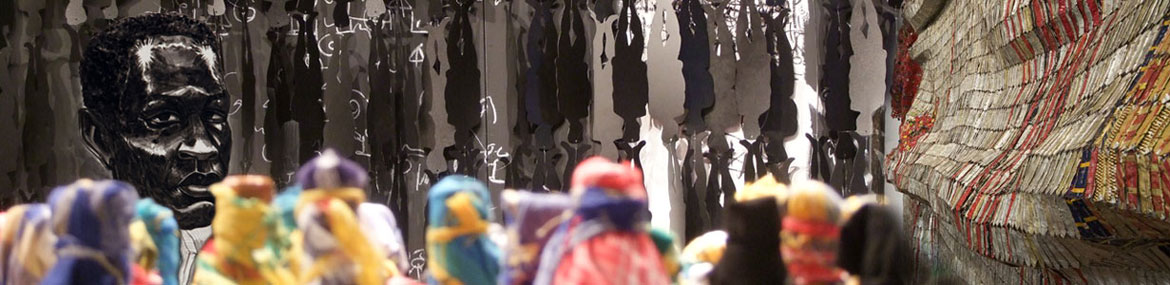

The National Gallery of Cayman Islands is taking the 4th edition of the Cayman Islands Biennial to new horizons by inviting U.S.- based curators for their themed exhibition, Archipelago. This multi-sited exhibition represents the best submissions from Caymanian artists across all three islands and the Diaspora to showcase the breadth of diversity and creativity in this Caribbean country.
ARCHIPELAGO
The Biennial runs until February 18, 2026 at the National Gallery and across several satellite spaces across Grand Cayman, Little Cayman, and Cayman Brac. These sites include the Cayman Islands National Museum, Gram Bella’s, the Mission House on Grand Cayman, the Little Cayman Museum, and Brac Heritage House. Admission to most sites is free to the public, as is the suite of programming that will animate the venues throughout the exhibition run.

Installation view
The curators of this biennial, Joseph L. Underwood and Davin Ebanks (JU and DE), are both affiliated with Kent State University in Ohio. I met Underwood previously in 2018 in Senegal. There, he presented a striking exhibition—The View From Here—featuring work by a number of African artists.
With him and his co-curator I have a mail interview.
RP: How do you see the intersection of research specialty and personal identity? I’m curious where that interest comes from?
JU: We live in an age of hyphenated identities. Davin is Caymanian and American by nationality. I am Chinese-American by heritage. I think when you consider a curator or curatorial team for a project, it’s less about the identity of the particular curator and more about looking to their practice to see if there are a proven record of empathy-seeking and an ability to translate the stories of others for different kinds of audiences.
RP:You were invited to curate this biennial not only because of your expertise, but also because you are both based in the USA. Can you explain that?
DE: Joseph and I have collaborated as colleagues at Kent State University (Ohio) for almost a decade. Whether it’s studio conversations about my own practice or co-teaching a seminar for students, we just appreciate the ways that we work in our respective disciplines, as a studio artist who works with mostly glass and an art historian who actively researches exhibition histories and maintains a curatorial practice. I believe I was invited to co-curate this edition of the Cayman Biennial because not only have I been deeply involved in the Caymanian art scene for decades (despite residing in the States), but I am a former recipient of the Bendel Hydes Award from the 2nd Cayman Islands Biennial. In a sense our partnership is a bridge between the wider art world and the Caymanian art scene, with me providing local context (through an academic lens) and Joseph providing expertise on curating and biennials specifically.

Deborah Kern, Roots in Colour, 2025
RP: The title of the biennial is Archipelago. Why this title? Does it refer to the setting in which it takes place, or does it also relate to the content of the works?
JU: Yes, as we evaluated almost 200 proposals from artists, we were able to distill the works into three different themes. But overarching that we really saw this push and pull between the perspectives of the individual and the identity/needs of the collective. We saw this as artists contended with nationality versus heritage identity vs immigrant. Or with perspectives on the local impact of climate change, but then the ways that would resonate with other coastal spaces around the world. And it’s just like an archipelago, which is—at the same time—a single entity, as a conglomerate of islands… but also made up of many or hundreds of distinct land masses that could be each considered an individual.
RP:Is there such a thing as Caymanian Art?
DE: no, there’s no way to recognize contemporary Caymanian art. There might be resonances with color palettes or icons from the Caribbean at large, but the population today comes from everywhere around the world. So, it’s almost an endless mixing of potential between the artist’s inherited identities and their recent or long-standing connection to the Cayman Islands. As to the question of unity, I think we are trying to figure that out right now. I know I appreciate being able to find cuisine from around the world here now, or see how different music and artistic influences are synthesizing with what was here when I grew up. I mean, when I was a kid there were 17,000 people and now the Islands are home to over 80,000. That’s an incredible increase in just 40 years.

Pam Kelly-Laurenson, Saturday Rush, 2025
RP: Does a country with more than 125 nationalities have a chance of forming a unity?
JU: It was exciting to curate this as a multi-site project to make sure all three Islands are involved, but also different communities across the Islands. And we curated it in such a way that it reflects an archipelago: you can visit any site in any order and still get an entry point to the full story. For example, at the Gram Bella’s site on Northside, two artists have created site-specific large-scale sculptures that respond to the open-air building. Stefan Langlois constructed a minimalist rendition of the Wreck of Ten Sails, which was an important event that highlights the hospitality of the residence though some argue it led to the nations status as a tax haven and opened the door for the rapid growth and inflation that led to the Islands being in the top ten most expensive costs of living in the world. Meanwhile Elizabeth Paige Smith’s rock sculptures are poignant reflections on the consequences of rapid development that leave so many communities vulnerable to displacement or extinction.

Installation, Gram Bella’s, Elizabeth Paige – Smith, 2025
RP: Did your choice to focus primarily on national and diaspora art have anything to do with the need to suggest/demonstrate that unity?
DE: This biennial is hosted by the National Gallery and has a mandate to feature Caymanian artists. The Gallery takes a pretty holistic view of that to include Caymanians who have moved abroad or have mixed heritage. But what was unique for this fourth edition is the invitation of an outside curator to really jump-start the dialogue and inject some new perspectives after curating it in-house since 2019.

Installation, Mission House. The Barnard Sandwich Boards, 2025
RP: Do you have an explanation for why Caribbean and related art is still hardly seen in Europe and the US?
DE: The Caribbean is incredibly diverse, and some of those nations have made stronger forays into the national and international markets. I think Joseph’s description of some of the work highlights that the content of the artwork is not only diverse, but (like all art) is concerned with what the artists know, what they feel, what impacts them in their world, whether that world is within the boundaries of our shores or not. Being familiar with other Caribbean artists, I think there is a kindred spirit here.
JU: Yes, and I think the next step is increased projects that are international scope but happen in the Caribbean. Once you move beyond some of the national(ist) projects and find more synergy, you’ll see that there are really a lot of artists who are operating with a rigor that could fit into any major museum or international biennial. I’m specifically thinking of some stellar pieces from (John) Reno Jackson or Linda McCann.
DE: And some artists who folks should definitely keep an eye on… like Andre Jennings and Michael Mothen.
