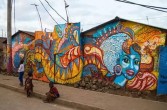
Street art has been a means of education, awareness raising, increasing knowledge and moulding public attitudes; which encourage constructive behaviours that can lead to a peaceful co-existence, mutual respect, common goals and aspirations.

Street art has been a means of education, awareness raising, increasing knowledge and moulding public attitudes; which encourage constructive behaviours that can lead to a peaceful co-existence, mutual respect, common goals and aspirations.

In fact arts’ own capacity for re-composition and self-realization is contingent on its ability to change the world. This utilitarian trait of art isn’t something forced upon it since art can choose otherwise. Art autonomy therefore is possible only when art chooses the path consistent with the agenda of constructing a revolutionary situation and subjectivity. Thami Mnyele Lives!

I feel it as one of the important tasks of a social engaged artist like myself and other artists, activists and cultural innovators to subvert and change the culture we find ourselves in. We are in a cultural war and, to echo Gordon Parks, the camera is our weapon of choice.

After a week of all kinds of art fairs, New York is looking back and reflecting on the results. Because the Armory 2016 decided to focus on Africa – ‘African Perspectives’ – African artists and African galleries got a lot of attention in the media. Is there more interest in contemporary African art? Is the African art market growing? Can we speak of a hype?

Edo Dijksterhuis reviewed the exhibition ‘What About Africa? 14 contemporary African artists’, organized by Africanah.org and Witteveen Visual Art Centre in Amsterdam. He calls the works top-notch but the concept of the exhibition highly problematic. “…..in this show they (the different countries) appear lumped together as if Africa were a homogeneous “country”—as it still is in many people’s minds.”